





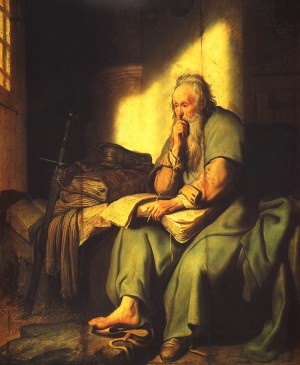
 What is the central theme of 2 Corinthians? I think Scott Hafemann is exactly right when he writes in the ESV Study Bible introduction to the letter that Paul’s primary emphasis is on “the relationship between suffering and the power of the Spirit in Paul’s apostolic life, ministry, and message.” Paul sees his own physical suffering and spiritual renewal—”though our outer self is wasting away, our inner self is being renewed day by day” (2 Cor. 4:16)—as a presentation of the death and resurrection of Jesus Christ.
Paul again and again hits on the theme that the weakness of his frame is designed to magnify the power of God’s name. Perhaps the most powerful section of the letter is in chapter 4 (vv. 8-12) where he talks about the purpose of his suffering:

We are afflicted in every way, but not crushed; perplexed, but not driven to despair; persecuted, but not forsaken; struck down, but not destroyed; always carrying in the body the death of Jesus, so that the life of Jesus may also be manifested in our bodies. For we who live are always being given over to death for Jesus’ sake, so that the life of Jesus also may be manifested in our mortal flesh. So death is at work in us, but life in you.
Do you see what Paul’s saying? His being beaten and beleagured is a picture of Jesus’ dying; his endurance and perseverance is a picture of the resurrection reality of Jesus’ life. Paul’s suffering and sanctification are designed to be walking advertisements for Good Friday and Easter Sunday:
| The Dying of Jesus | The Resurrection Life of Jesus |
| afflicted in every way | not crushed |
| perplexed | not driven to despair |
| persecuted | not forsaken |
| struck down | not destroyed |
Paul saw the purpose of his suffering as a means to mediate, manifest, and magnify the resurrection power of his Savior.
We can see Paul’s radical other-centeredness in 2 Cor. 4:15, as he talks about why he endures such pain:
It is all for your sake, so that as grace extends to more and more people it may increase thanksgiving, to the glory of God.
Paul is willing to endure incredible hardship as long as it means more grace leading to more gratitude leading to more glory for God.
In 2 Cor. 11:23-28 Paul reluctantly recounts his resume of suffering, which included imprisonments, countless beatings, and near-death experiences:
- whipped with 39 lashes (5 different times)
- beaten with rods (3 different times)
- pummeled with stones (1 time)
- shipwrecked (3 times)
- adrift at sea (one night, one day)
- journeys (frequent)
- danger from rivers
- danger from robbers
- danger from his own people
- danger from Gentiles
- danger in the city
- danger in the wilderness
- danger at sea
- danger from false brothers
- toil and hardship
- sleepless nights (many)
- hungry and thirsty (often)
- cold and exposed
- the pressure of anxiety for all the churches (daily)
And yet given his radically God-centered worldview, Paul calls such suffering “light” and “momentary”!
For this light momentary affliction is preparing for us an eternal weight of glory beyond all comparison, as we look not to the things that are seen but to the things that are unseen. For the things that are seen are transient, but the things that are unseen are eternal. (2 Cor. 4:17-18)
Paul knew that no matter how much it hurt in the hear-and-now, it was as nothing compared to the hope and healing that he would experience for eternity in the presence of his Savior. We “walk by faith, not by sight” (2 Cor. 5:7), knowing that “faith is the assurance of things hoped for, the conviction of things not seen” (Heb. 11:1). So from Paul’s perspective, the comparison and contrast of now and then—here and there—looks like this:
| Earthly Perspective | Eternal Perspective |
| light | weight |
| momentary | eternal |
| affliction | glory |
| seen | unseen |
| transient | eternal |
May God give all of us grace to suffer well, as living advertisements for the death of Christ and the life of Christ, as we live in light of eternity.


