





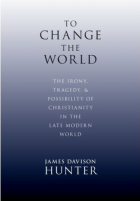
 I suspect this will be one of the most important books published in 2010. This April Oxford University Press will release a book by renowned sociologist and cultural critic James Davison Hunter, entitled, To Change the World: The Irony, Tragedy, and Possibility of Christianity in the Late Modern World (hardcover, 368 pp., $18.86 at Amazon).
The book consists of three essays, or clusters of chapters:

- Christianity and World Changing
- Rethinking Power
- Toward a New City Commons: Reflections on a Theology of Faithful Presence
Challenging the unreflective activism of typical cultural engagement by Christians, Hunter writes:
I contend that the dominant ways of thinking about culture and cultural change are flawed, for they are based upon both specious social science and problematic theology. In brief, the model upon which various strategies are based not only does not work, but it cannot work.
Rejecting models of defensiveness, relevance, or withdrawal, Hunter argues for a theology of “faithful presence”: “A theology of faithful presence calls Christians to enact the shalom of God in the circumstances in which God has placed them and to actively seek it on behalf of others.” For more explanation, see the end of this post.
Here are some endorsements for the book:
“No writer or thinker has taught me as much as James Hunter has about this all-important and complex subject of how culture is changed.” — Tim Keller, author of Counterfeit Gods: The Empty Promises of Money, Sex, and Power
“For anyone interested in American Christianity, whether believer or observer, this is an extraordinarily important and valuable book. Hunter’s analysis of culture and the capacity of Christians to influence it (or not) is the most sophisticated and subtle I have ever seen, explaining why most treatments of the subject are gravely inadequate. His treatment of religion and power in the American context is similarly illuminating. Finally his theology of faithful presence offers a promising alternative to most of the approaches on offer today whether from liberals or conservatives. The encounter of social science and theology has often been vapid; Hunter shows how vibrant it can be.” — Robert Bellah, author of Habits of the Heart
“How should Christians act in the world? The dominant answer in America today seems to be: through politics. But the major model of Christian political action, visible most obviously but not exclusively in the Christian Right, has been a politics fueled by resentment and a sense of victimization, actuated by a strong will to power, and a propensity to demonize its opponents. This politics is a capitulation to the worst elements of the contemporary culture it claims to be redeeming. Hunter offers an acute and penetrating analysis of this paradoxical and distressing phenomenon, and carefully charts an alternative course for contemporary Christians, a form of “faithful presence” within culture and society. The book is brimful of insightful challenges to our conventional understanding of things and of inspiring suggestions for a new departure.” — Charles Taylor, author of A Secular Age
“To Change the World is a wonderful book in too many ways to tell. Hunter takes a topic that has become tired and weary from over-much talk and infuses it with new life, the topic of how Christians can change the world. He compelling argues that all the main parties to the discussion assume that change will come about if laypeople just get the right thoughts in their heads and then apply them; change will ooze up from below. He argues, with a fascinating blend of social theory and historical examples that cultural change rarely if ever comes about this way. It is cultural elites who spur cultural change. The model that he then proposes for how Christians should relate to culture, in place of the defensive, accomodationist, and isolationist models that fill the air, is what he call ‘faithful presence.’ The book is a feat of great intellectual imagination, lucidly written, theoretically sophisticated, balanced and thorough, wide-ranging in its examples. No one who thinks about these matters can afford to ignore it.” — Nicholas Wolterstorff, Noah Porter Professor Emeritus of Philosophical Theology, Yale University
“To change hearts and minds has been the goal of modern Christians seeking to correct a culture deemed fallen and morally lax. Hunter (Culture Wars), a distinguished professor of religion, culture, and social theory at the University of Virginia, finds this approach pervasive among Christians of all stripes and in every case deeply flawed. It can even undermine the message of the very gospel they cherish and desire to advance. In three essays—groups of chapters developing a concept—Hunter charts the history of Christian assumptions and efforts, investigates the nature of power and politics in Christian life and thought, and then proposes a theologically sound alternative: what he calls the practice of faithful presence. This practice has benevolent consequences . . . precisely because it is not rooted in a desire to change the world . . . but rather it is an expression of a desire to honor the creator of all goodness, beauty, and truth. Well reasoned and thought provoking, Hunter’s corrective argument for authentic Christian engagement with the world is refreshing, persuasive, and inspiring.” — Publishers Weekly
Here is more description of the book from Oxford University Press:
“In his forthcoming book, To Change The World: The Irony, Tragedy, and Possibility of Christianity in the Late Modern World, James Hunter calls the church to adopt a public posture of faithful presence. He writes, “A theology of faithful presence calls Christians to enact the shalom of God in the circumstances in which God has placed them and to actively seek it on behalf of others.” Faithful presence is not the starting point of Hunter’s book, but its conclusion. Two-thirds of the book is devoted to understanding how culture is changed and the appropriate role of power in this process. Coming to faithful presence requires first clearing years of erroneous assumptions. It’s a new paradigm, not a new program.
Faithful presence is contrasted to three other postures towards public life—what Hunter calls “paradigms of engagement”—that have been adopted by the church in the recent past. Faithful presence can be clarified by underscoring what it is not.
It’s not a defensive enclave set against the world. For those who adopt this vision the main problem is secularity, “if only God could be re-enshrined in the social order the culture would be restored.” One can think of this as a lament over lost market share.
It’s not relevance to culture, where the priority is being connected to the pressing issues of the day or the felt-needs of the person in the pew or more importantly the felt-needs of the nonbeliever. This posture focuses its sharpest critique not on contemporary culture but on the established church. One can think of this as a branding crisis.
And finally, it’s not purity from culture, where active engagement in culture is abandoned for a call to authentic witness. This posture adopts the view that the “church has no other obligation other than to be itself.” While expressed in many different ways and through various traditions, it feeds on the logic of “us-against-them.” One can think of this as a new monasticism.
In contrast, the foundation of faithful presence is the incarnation and Jesus’ example of “pursuit, identification, and offer of life through sacrificial love.” The same should be evident in our relationships with others, in the exercise of our vocations, and in the spheres of our public influence. “What this means,” writes Hunter, “is that where and to the extent that we are able, faithful presence commits us to do what we can to create conditions in the structures of social life we inhabit that are conducive to the flourishing of all.”
Make no mistake about what is required. The church’s flourishing is tied directly to the flourishing of the community in which it lives and works. Our shalom is found in the shalom of others. This is the calling and cost of faithful presence. So it was for Jesus. So it is for the church. It works on the court just as in life.
The call to make the world a better place is inherent in the Christian belief and practice. But why have efforts to change the world by Christians so often failed or gone tragically awry? And how might Christians in the 21st century live in ways that have integrity with their traditions and are more truly transformative? In To Change the World, James Davison Hunter offers persuasive—and provocative—answers to these questions.
Hunter begins with a penetrating appraisal of the most popular models of world-changing among Christians today, highlighting the ways they are inherently flawed and therefore incapable of generating the change to which they aspire. Because change implies power, all Christian eventually embrace strategies of political engagement. Hunter offers a trenchant critique of the political theologies of the Christian Right and Left and the Neo-Anabaptists, taking on many respected leaders, from Charles Colson to Jim Wallis and Stanley Hauerwas. Hunter argues that all too often these political theologies worsen the very problems they are designed to solve. What is really needed is a different paradigm of Christian engagement with the world, one that Hunter calls “faithful presence”—an ideal of Christian practice that is not only individual but institutional; a model that plays out not only in all relationships but in our work and all spheres of social life. He offers real-life examples, large and small, of what can be accomplished through the practice of “faithful presence.” Such practices will be more fruitful, Hunter argues, more exemplary, and more deeply transfiguring than any more overtly ambitious attempts can ever be.
Written with keen insight, deep faith, and profound historical grasp, To Change the World will forever change the way Christians view and talk about their role in the modern world.


