

This is a cross-post from Tim Keller’s blog at Redeemer City to City.
In reading what a number of respected Christian authors have said over the years about polemics and theological controversy, I have distilled a few rules. These rules, I believe, will help us neither avoid polemics nor engage in them in a spiritually destructive way. Almost every rule is mentioned in some ways by multiple authors, but when a writer has put a principle in a particularly strong or apt way, I’ve put his name on the rule.
1. Carson’s Rule: You don’t have to follow Matthew 18 before publishing polemics.
Don Carson wrote an editorial on Abusing Matthew 18 in which he addresses the often-made argument that a Christian should not publicly write criticism of other Christians’ theological views without going to them first, privately, citing Matthew 18. But Carson points out that this passage is talking about two people in the same church, or at least in the same ecclesiastical connection, since if the two parties disagree the whole matter can be taken to “the church,” meaning the congregation and its leaders. Also, the sin described in Matthew 18 is still “relatively private, noticed by one or two believers, yet serious enough to be brought to the attention of the church if the offender refuses to turn away from it.” But public teaching that contradicts sound doctrine is in a whole different category. Carson points to Titus 1:9 that says that the godly elder must “encourage others by sound doctrine and refute those who oppose it.” In short, if someone is publicly presenting theological views that are opposed to sound doctrine, and you are not in the same ecclesiastical body with this person (that is, there is no body of elders over you both, as when, for example, both of you are ministers in the same denomination) then you may indeed publicly oppose those without going privately to the author of them. Carson does add a qualifier, but that comes under the next rule.
2. Murray’s Rule: You must take full responsibility for even unwitting misrepresentation of someone’s views.
Don Carson says that if you have strong concerns about Mr. A’s views, and you are considering publishing a critique, it may be wise to go to Mr. A first, but “not out of obedience to Matthew 18, which really does not pertain, but to determine just what the views of the [other person] really are.” This fits with some startling strong words by Westminster Seminary theologian John Murray. In his book Principles of Conduct he argues that “all falsehood, error, misapprehension, every deviation from what is true in thought, feeling, word, or action is the result of sin. . . . Quite apart from sin there would have been ignorance and lack of full understanding on the part of all created rational beings. But limited knowledge is one thing, falsehood in understanding or representation is another” (p. 132). In other words, to misrepresent reality to others is always wrong. He grants, of course, that there is a great difference between a deliberate lie and unintentionally passing on erroneous information. But he goes on: “[W]e think very superficially and naïvely if we suppose that no wrong is entailed in purveying misrepresentation of fact. Even when persons are, as we say, the innocent victims of misinformation, we are not to suppose that they are relieved of all wrong. What we need to appreciate is that the representation is false . . . a misrepresentation of God’s truth.” He concludes: “This consideration that all falsehood, as a deviation from truth, is per se wrong should arouse us to the gravity of our situation in relation to the prevalence of falsehood and to our responsibility in guarding, maintaining, and promoting truth” (p. 132).
This is very sobering. In our internet age we are very quick to dash off a response because we think Mr. A promotes X. And when someone points out that Mr. A didn’t mean X because over here he said Y, we simply apologize, or maybe we don’t even do that. John Murray’s principle means that polemics must never be “dashed off.” Great care should be taken to be sure you really know what Mr. A believes and promotes before you publish. This leads to a related rule from Archibald Alexander.
3. Alexander’s Rule: Never attribute an opinion to your opponent that he himself does not own.
Archibald Alexander urged his students to be fair and temperate when they pursued theological controversy. They were to “strive for truth, not victory,” and they were to “know when to put a stop to controversy. It is a great evil in keeping it up” unnecessarily. He also urged them to not go public with criticism unless the error was very dangerous and important. Like Lloyd-Jones and (as we will see) John Calvin, Alexander taught that the ultimate purpose of controversy was to persuade and win over people in error. Therefore we must “avoid whatever is apt to create prejudice in opponents or auditors.” In other words, we must not argue in such a way that it hardens opponents in their views. (See David Calhoun, Princeton Seminary, vol I, p. 92.)
Perhaps Alexander’s most interesting rule however, was this: “Attribute to an antagonist no opinion he does not own, though it be a necessary consequence” (Calhoun, p. 92). In other words, even if you believe that Mr. A’s belief X could or will lead others who hold that position to belief Y, do not accuse Mr. A of holding to belief Y himself, if he disowns it. You may consider him inconsistent, but it is one thing to say that and another thing to tar him with belief Y by implying or insisting that he actually holds it when he does not. A similar move happens when you imply or argue that, if Mr. A quotes a particular author favorably at any point, then Mr. A must hold to all the views that the author holds at other points. If you, through guilt-by-association, hint or insist that Mr. A must hold other beliefs of that particular author, then you are violating Alexander’s Rule and, indeed, Murray’s Rule. You are misrepresenting your opponent.
More to come in my next post.
Is there enough evidence for us to believe the Gospels?
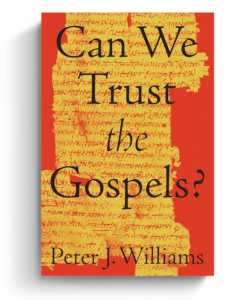 In an age of faith deconstruction and skepticism about the Bible’s authority, it’s common to hear claims that the Gospels are unreliable propaganda. And if the Gospels are shown to be historically unreliable, the whole foundation of Christianity begins to crumble.