

Dec
08
2009
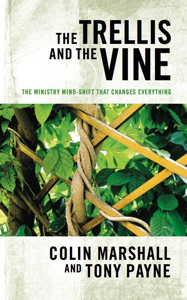
Key Points in The Trellis and the Vine
Thanks to Tim Chester for reproducing some summary statements from The Trellis and the Vine:
Ministry Mind-shifts
- From running programs to building people
- From running events to training people
- From using people to growing people
- From filling gaps to training new workers
- From solving problems to helping people make progress
- From clinging to ordained ministry to developing team leadership
- From focusing on church polity to forging ministry partnerships
- From relying on training institutions to establishing local training
- From focusing on immediate pressures to aiming for long-term expansion
- From engaging in management to engaging in ministry
- From seeking church growth to desiring gospel growth
Summary Propositions
- Our goal is to make disciples
- Churches tend towards institutionalism as sparks fly upwards
- The heart of disciple-making is prayerful teaching
- The goal of all ministry—not just one-to-one work—is to nurture disciples
- To be a disciple is to be a disciple-maker
- Disciple-makers need to be trained and equipped in conviction, character, and competence
- There is only one class of disciples, regardless of different roles or responsibilities
- The Great Commission, and its disciple-making imperative, needs to drive fresh thinking about our Sunday meetings and the place of training in congregational life
- Training almost always starts small and grows by multiplying workers
- We need to challenge and recruit the next generation of pastors, teachers, and evangelists
Steps to Making a Start
- Set the agenda on Sundays
- Work closely with your elders or parish council
- Start building a new team of co-workers
- Work out with you co-workers how disciple-making is going to grow in your context
- Run some training programs
- Keep an eye out for “people worth watching”
13 Comments
Very helpful. Thanks.
z
Keep in mind that this language and the content was used ten to fifteen years ago in most of the popular business literature at the time. Just replace the wording with “employees” or “associates” and you end up with the business model of the nineties.
I don’t mean to be cynical, although I will be skeptical. The model is still a business one, with a group of ceo’s at the top, a hierarchy of “leaders” and “laity” underneath. Keeping an eye out for the “talent”, etc. “Recruit” the next generation.
If our model really is the NT, then this is still a far cry from real church life. Just more theatre and spectacle, more “man up front” stuff. Not “one anothering” or mutual edification, but rather more of the same with new terms.
Also, the regular meetings of the church is not about training, it is about knowing Christ, of relishing His presence.
Chris,
While I think I understand some of your concerns, I wonder if you have read the book. While I haven’t read the book yet (it is on my desk “next in line” to be read, I was at the Gospel Growth = People Growth Conference in Oct. where much of these concepts were talked about. To hear Tony Payne or Phillip Jensen for that matter talk about these things, I don’t think they are coming from the angle that you think they are. If you haven’t read the book I would encourage you to give it a go.
In fact the audio from the conference can be found at this link:
http://peoplegrowth.org/index.php?option=com_content&view=article&id=74&Itemid=89
Chris,
This represents the book, which argues explicitly against a CEO model.
JT
Justin,
I have no doubt that they say this, but the pronoun is still implied in the phrases: “building…”, “developing…”, “establishing…”, “recruit…”, “building a new team” etc. Who is doing this? Answer: a professional “minister”. The one-man model, or pyramid-plan, is still the necessary structure of what is being suggested.
The model currently on offer, with the central figure up front, “leading” the people is still the dominant feature of these suggestions. He is the drive engine of the whole affair. Christ, mediated through him as he leads, is implied, even if not intended.
I am a presbyterian in my background, but am leaning towards what Steve Schlissel has called an “organic presbyterianism” in which elders really are old-men, not officers. The elderly men are leaders by age and wisdom, and their “appointment” is one of recognition, not democratic election.
Shannon,
Phillip Jensen is a clergyman in Sydney, so he is invested in maintaining the hierarchy of the current system. I appreciate him, have heard his sermons, and like his style as an iconoclast of English Anglicanism. But, he is still a central figure of system that creates and elevates central figures, rather than Christ.
What is happening within many branches of Christendom is the realization that the system is not working, and so new models are being attempted, or at least suggested. But, what they fail to really recognize is that the system itself, in which they are attempting to function, is the problem. The system militates against what they are hoping will happen.
No I have not read the book. But if you check out my Librarything page you will see what I have read and my ecclesiastical background. http://www.xristopher.com
I hate to sound smug, but there is not anything “new” that can be said. Rather, we need to dig deeper into the NT and find our way back to the Lord’s Way. Hierarchies are not the Lord’s way.
Chris,
“Hierarchies are not the Lord’s way.”
Really? You could have fooled me.
Let’s see.. for starters.
God -> Moses -> Lieutenants -> Israel
God -> Joshua -> Lieutenants? -> Israel
[other OT examples left out for brevity]
Christ -> The close 3 -> The rest of the 12 -> The 72 -> the masses
Apostles -> Church Elders and Deacons -> Local Church
Grant it, there isn’t a clear “one guy calling the shots” in the Apostles line, but if there wasn’t there was at least a guy who got the ball rolling and kept things moving (I suspect that was Peter but only by personality.) Otherwise you end up with chaos.
OT examples are types and figures of Christ. Do you agree? No time to list the numerous passages that point them forward to the true Prophet-Priest-King. Christ is the central figure of the OT, not Moses or David or Joshua. If you don’t take them as types, then you run into some strange applications for modern church life, like armed combat against pagans.
I don’t want to get into a heated discussion or the minutia of the details in this blog. My initial statements were about the book and the outline. There is room for much more discussion, but please don’t take from what I have said that I am against leadership or structure of any kind. I am simply suggesting that the models that have dominated for 700 hundred years need to be reconsidered.
The Lord’s blessings,
Chris
[...] Tim Chester has put up a review here and Justin Taylor quotes Chester here. [...]
Wanted to make sure you knew that the book is half off from now until Dec. 8th at their website.
Chris, if you have the time, can you expand on what your idea of a church community ought to look like, with a few more examples? What you have said resonates with me, in that I’m becoming wary of the sophisticated ways we can have of justifying the chasing of church management techniques instead of “running the race”.
It’s a similar feeling that I get when I read business handbooks and “zen marketing” blogs…I read it, and I think “this all makes sense! Why didn’t I think of doing it that way?” And I get all stoked and resolve to implement these new procedures, and it lasts about 5 minutes before things break down somehow. I’ve heard motivational speakers talk about all you need for success, and they don’t really mention is that the thing that is most likely going to make you successful is idolising success. You’ve got to want it more than *anything*.
So success in running a church can be our idol instead of glorifying God. I think it’s even possible to make “preaching against idols” into your own little success idol. Are you perhaps hinting that dedicating a book to church management structure can send out a message that management is the thing which is most important? It perhaps makes an inference that we are not dependent completely on God after all (and don’t our unregenerate hearts love to hear *that* kind of news?)
I really don’t want to be ungracious to the authors of this book in discussing this idea, though. I’m just interested to hear your responses to my thoughts.
Smart people are just as sinful as simple people. The problem is, when you’re smart, it’s much easier to cover your idolatry in sophisticated ways, and it takes a lot longer to explain to a smart person how they might be wrong. But at the root of it, we’re all inclined to go wrong for the same reasons, and the solution is the same: we depend entirely on God to rescue us from our waywardness!
Just some random thoughts, I hope I’ve not gone too off-topic with this one!
Beat (you must be a musician, no?),
I am going through a serious paradigm shift in my thinking at the moment. After 13 years in the PCA and other highly structured settings before that, I am moving away from the idea that a single man ministry, or a professional ministry for that matter, should exist at all. The book of Acts is the model I am looking at, as well as the, misnamed, “pastoral epistles”. Much of what I am seeing is more along the lines of an embedded and integrated life of the church. What I mean by that is that there is no pulpit up front, no auditorium, no choir, no bands, no sanctuary buildings, no staff, etc. No professionally trained “ministers” who are looking for a job. No massive buildings based on piles of debt. Gone.
But, on the flip-side, there is mutual edification. Numerous kinds of meetings. All-member ministry, and no little people. Ancient church history, prior to Constantine, provides many good examples. This was before the church caved into the Roman style of “worship” in which a trained rhetorician lead the show, and everything came to depend upon him.
With the full knowledge that I might get some digital stones thrown at me for suggesting this, an author who is doing some good work on this stuff is Frank Viola. He is iconoclastic in his first book, Pagan Christianity, but in the books following that one he begins to explain the path I am hinting at.
Any way, take care. I am visiting your website later.
in Christ,
c
[...] Summary of a good new book, The Trellis and the Vine. I’ve ordered copies for our elders. [...]